
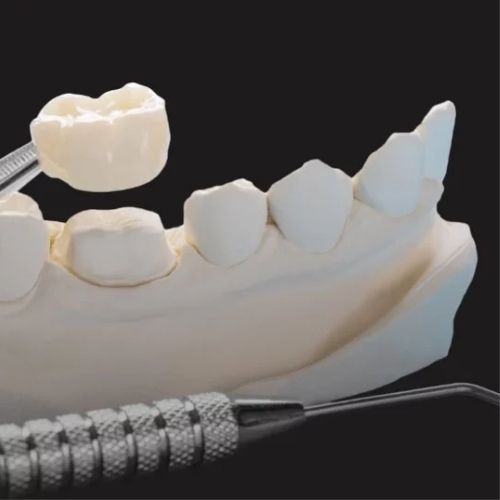
The dental crown: protection and reconstruction in cases of severe substance loss
A dental crown is always used when a tooth is so severely damaged that a conventional filling or inlay is no longer sufficient to ensure stability. A crown can be thought of as a protective cap that completely encloses the prepared tooth. At The Eram Clinic, we prefer to use all-ceramic solutions. Ceramic is the material of choice when it comes to naturalness and biocompatibility. It does not conduct temperatures, is completely metal-free and has a refractive index that is deceptively similar to natural enamel.
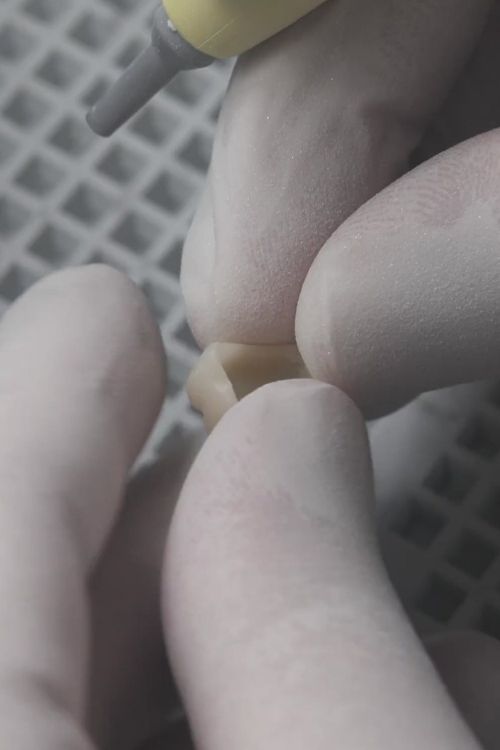
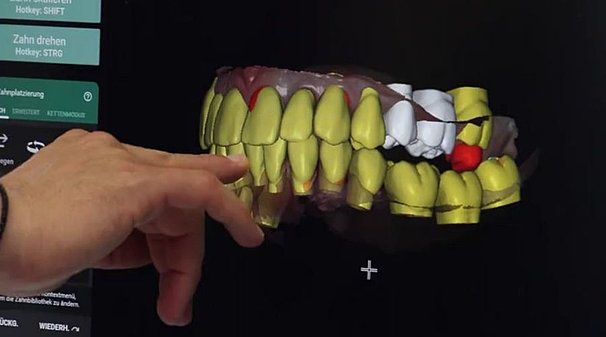
The process of fitting a crown begins with extremely precise preparation of the tooth. We remove damaged areas and reshape the tooth so that the crown fits perfectly. Thanks to modern digital impression techniques, we can often dispense with the conventional impression method using a tray and impression material, which is often perceived as unpleasant. The crown is then individually modelled for you in close collaboration with first-class dental technicians. We pay meticulous attention to the contact points with the adjacent teeth and the perfect fit in the bite in order to avoid long-term consequences such as temporomandibular joint problems.
The dental bridge: Aesthetic gap closure without compromise
If one or more teeth are completely missing, a bridge is a proven method of closing the resulting gap with a fixed restoration. A bridge consists of the so-called bridge abutments – the teeth to the left and right of the gap – and the bridge element in between, which replaces the missing tooth. At The Eram Clinic, we attach great importance to ensuring that a bridge not only restores chewing function, but also fits seamlessly into the row of teeth without visible edges or transitions.
Closing a gap is medically advisable, as missing teeth can cause the neighbouring teeth to tilt into the gap or the opposite tooth to ‘grow’ into the free space. This can destabilise the entire chewing system. With a bridge made of high-quality zirconium oxide ceramic, we offer you a solution that is extremely resilient and highly aesthetic at the same time. For patients who prefer an even more tooth-friendly option and whose adjacent teeth are completely healthy, we at The Eram Clinic also consider alternative options such as implant-supported crowns to avoid grinding down healthy tooth structure.
Why high-quality dentures are an excellent choice for your quality of life
Choosing first-class crowns and bridges is an investment in your long-term quality of life. Cheap dentures made from inferior materials can often lead to gum irritation, dark edges or unnatural colours. At The Eram Clinic, we only use materials that meet the highest biological standards. All-ceramic is allergen-free and prevents the dreaded ‘battery effect’ that can occur with different metals in the mouth. In addition, the smooth surface of the ceramic ensures that plaque and bacteria are less likely to adhere, which actively supports the health of your gums. You will regain a smile that gives you confidence when speaking, laughing and eating.
Advantages of crowns and bridges
- All-ceramic aesthetics: Natural light transparency and perfect colour matching for invisible transitions.
- Biocompatibility: Metal-free dentures that eliminate gum irritation and allergies.
- Highest precision: Exact fit thanks to digital planning procedures and master craftsmanship.
- Restoration of function: Stable bite and protection of the remaining tooth substance from incorrect loading.
- Durability: Use of high-performance ceramics such as zirconium oxide for maximum resilience.
| Treatment duration | Usually 2 to 3 appointments within 14 days |
| Materials | E-Max ceramic, zirconium oxide, high-performance ceramic |
| Durability | Approximately 10 to 20 years with optimal care |
| Pain-free | Local anaesthesia during preparation |
| Aesthetics | Individual colour matching and shaping |
Comprehensive support: Care and maintenance of your dentures
At The Eram Clinic, our care does not end with the insertion of your new crown or bridge. High-quality dentures require just as much care as your natural teeth. The transitions between the gums and ceramics, as well as the areas under the bridge elements, require particular attention. We integrate your new restorations into a comprehensive professional dental hygiene concept. Our specialists will also show you specific techniques for home care, such as the use of interdental brushes or special Superfloss dental floss.
A healthy foundation is also the basis for any aesthetic procedure. If you are planning to have your teeth whitened, we recommend doing so before the final crowns or bridges are made. Since ceramic cannot be whitened afterwards, we match the colour of your new dentures directly to your bright, whitened smile. After treatment in our modern premises in Zurich, we will accompany you with regular check-ups to ensure that your dentures remain functional and aesthetically perfect for many years to come. Our goal is for you to forget that you are wearing dentures at all.
Procedure at The Eram Clinic
We attach great importance to transparent communication about the treatment steps and the associated investment. Each set of dentures is a masterpiece custom-made for you.
Restore the harmony of your smile
Don't settle for compromises when it comes to your dentures. At The Eram Clinic in Zurich, we combine state-of-the-art digital dentistry with an exclusive understanding of aesthetic details. Secure your appointment for a consultation and experience how crowns and bridges can permanently improve your quality of life and self-confidence.
Frequently asked questions about crowns and bridges
There is usually about a week between the first appointment (preparation and scan) and the insertion of the finished work. During this time, you will wear a high-quality temporary restoration that protects your tooth and maintains aesthetics and chewing function.
Thanks to modern local anaesthesia, the preparation of the teeth is completely painless. After the treatment, the tooth may be slightly more sensitive to temperature stimuli for a short time, but this usually subsides completely once the final crown has been fitted.
An inlay is used when the defect is inside the tooth and the supporting cusps are still stable. A crown is necessary when the outer structure of the tooth is so weakened that the tooth must be ‘held together’ and protected by the crown.
The bridge itself cannot develop caries, but the abutment teeth at the transition points to the gums are at risk. That is why excellent oral hygiene and cleaning the spaces between the bridge are so important for long-term preservation.
All-ceramic is the most aesthetic and health-friendly material. It avoids the grey edge at the gum line that often becomes visible after a few years with ceramic crowns with a metal core when the gums recede slightly.
